My Secret to Cheaper UK Hotel Stays: A Deep Dive into trivago
Let’s be real for a moment. Planning a trip, even a simple weekend away in the UK, can sometimes feel like a second job. You find a hotel you like the look of. You open its website in one tab. Then you open Booking.com in another. Then Expedia. Then Hotels.com. Before you know it, you’ve got a dozen tabs open, your browser is groaning under the pressure, and you’re cross-eyed from trying to compare prices that all seem to be slightly different. It’s enough to make you want to just stay home.
I’ve been there more times than I can count. That frantic pre-holiday scramble, convinced I’m about to be ripped off, spending hours searching for a deal that might save me a tenner. It used to be my least favourite part of travelling. That is, until I properly figured out how to use trivago.
You’ve seen the adverts, I’m sure. The ones that promise to help you “find your ideal hotel for the best price.” But does it actually work, or is it just another layer of complexity? I decided to put it to the test for my own travels, from city breaks in Scotland to coastal retreats in Cornwall. This is my story, a full rundown of my experience using trivago – the good, the bad, and the genuinely money-saving.
So, What Exactly Is trivago? (It’s Not What You Might Think)
First things first, let’s clear up a common misconception. You don’t actually book a hotel on trivago. It’s not a travel agent or a booking site like Booking.com. Think of it more like a super-smart, hotel-obsessed search engine.
In technical terms, it’s a ‘metasearch engine’. In human terms, it scours hundreds of different booking websites and hotel chains all at once – from the big players like Expedia and Agoda to smaller, more obscure sites you’ve probably never heard of. It then gathers all those prices for the exact same hotel room and lays them out for you on one single page. The goal is simple: to show you where the cheapest price is hiding for the hotel you want to book.
The main promise is that it saves you two things: time and money. Instead of you having to do the twenty-tab dance, trivago does the legwork for you. That’s the theory, anyway. It was time for me to see how it held up in practice.
My First Real Test: Planning a Weekend in Edinburgh
My partner and I were desperate for a long weekend away. We settled on Edinburgh – a city I love but hadn’t visited in years. This felt like the perfect opportunity to give trivago a proper go. I fired up my laptop, took a deep breath, and dived in.
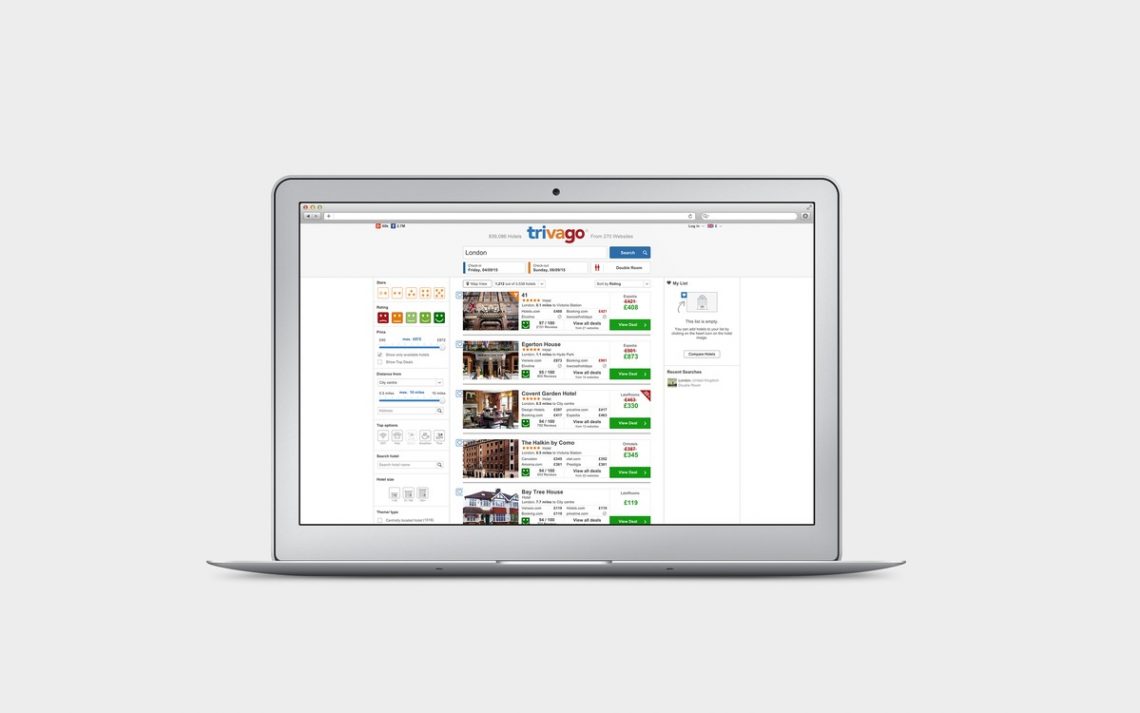
The homepage is refreshingly simple. Just a big search bar asking where you want to go. I typed in “Edinburgh,” selected our dates in October, and hit search. A second later, a list of hundreds of hotels appeared. Honestly, my first reaction was a slight sense of panic. The sheer number of options was overwhelming. But this is where the magic really begins.
On the side of the page was the filter menu. This, I quickly realised, is trivago’s superpower. I wasn’t just looking for any hotel; I had a specific checklist:
- Location: We wanted to be within walking distance of the Royal Mile.
- Budget: We were aiming for under £150 a night.
- Rating: I rarely book anywhere with a rating below 8/10 or 4/5 stars. Life’s too short for bad hotels.
- Amenities: Free Wi-Fi was non-negotiable, and a free breakfast would be a huge bonus.
I started clicking. First, I used the map view to draw a circle around the Old Town area. This immediately eliminated all the hotels on the outskirts. Then, I set the price slider to a maximum of £150. I filtered by “Guest rating” to show only “Very good” or “Excellent” options. Finally, I ticked the boxes for “Free Wi-Fi” and “Free Breakfast.”
In less than a minute, a list of over 500 hotels had been whittled down to a manageable eight. Now for the interesting part. I clicked on the top result, a lovely-looking boutique hotel just off Grassmarket. And there it was, laid out in black and white. trivago was showing me the price for a double room at this hotel from five different websites. Expedia was offering it for £145. Booking.com had it for £142. But a smaller site called Ebookers had the exact same room, for the same dates, for just £128 per night.
That was my “Aha!” moment. I would never have thought to check that third website on my own. By using Visit Official trivago Website Now, I’d found a saving of £17 a night, or £51 over our three-night stay. That’s a couple of nice distillery tours or a very decent dinner, right there. I clicked the deal, was taken directly to the Ebookers website to complete the booking, and it was all done. Simple, efficient, and cheaper.
What Other Travellers Are Saying
Of course, that’s just my experience. I was curious to see what other people thought, so I did a little digging. The feedback seems to be largely positive, with a few common-sense caveats.
“I’ve been using trivago for years for our family holidays. It’s my go-to starting point. Last year, it found us a deal on an all-inclusive in Spain that was hundreds cheaper than what my friends paid booking direct. The filters are a godsend for finding family-friendly places.”
– Sarah from Manchester.
“The map view on trivago is brilliant. When I was booking a trip to London, I could see all the hotels near the Tube station I wanted. It saved me so much time trying to cross-reference with Google Maps.”
– Chloe from Glasgow.
“It’s useful for a quick price check, for sure. But I did have an issue once where the price on trivago was lower, but when I clicked through to the booking site, it had updated and was more expensive. A bit frustrating, but I still use it to get a general idea.”
– Mark from Bristol.
Mark’s point is a valid one, and something I’ll touch on in a moment. Prices in the travel world can change in the blink of an eye, so what you see on trivago is a snapshot. It’s usually accurate, but it’s always the price on the final booking site that counts.
The Good, The Bad, and The Nitty-Gritty of Using trivago
After using the platform for several more trips – a cheap and cheerful night in Brighton, a family get-together in the Cotswolds, and planning a future trip to York – I’ve got a pretty good handle on its strengths and weaknesses.
The Good Stuff (The Pros)
- The Ultimate Time-Saver: This is the biggest win for me. The days of having countless tabs open are over. One search on trivago replaces hours of manual comparison. It brings the whole market to you.
- Genuine Price Comparison: Seeing the different prices for the exact same room side-by-side is incredibly powerful. It exposes the fact that loyalty to one booking site rarely pays off.
- The Power of the Filters: I can’t praise the filters enough. Whether you want a hotel with a pool, one that allows pets, or one that has an electric vehicle charging station, you can narrow it down with a few clicks.
- Aggregated Reviews: Instead of just relying on Booking.com’s reviews or TripAdvisor’s, trivago pulls in ratings from multiple sources, giving you a more balanced and reliable overall score for each hotel.
- Price Alerts Are a Game-Changer: For a trip I was planning to Cornwall, I wasn’t ready to book yet. I found a hotel I loved and set a Price Alert on Visit Official trivago Website Now. A few weeks later, I got an email saying the price had dropped by 15% for my dates. I booked it immediately. It’s a brilliant feature for anyone who plans ahead.
The Not-So-Good Stuff (The Cons)
- You’re Dealing with a Middleman: This is crucial to understand. You don’t book with trivago. It passes you over to the booking site (like Expedia, Agoda, etc.). This means if you have a problem with your reservation, you need to contact the site you actually paid, not trivago. Their customer service can’t help with booking issues.
- Prices Can Sometimes Be Out of Sync: As Mark from Bristol mentioned, occasionally the price displayed on trivago isn’t the one you see when you click through. This can be due to caching delays or the booking site adding taxes and fees on the final page. It’s not common, but it can happen. Always treat the price on the final checkout page as the correct one.
- Sponsored Listings: Like any search engine, trivago has to make money. Some hotels pay for better visibility. This isn’t necessarily a bad thing, but it’s why I never just look at the default “Our recommendations” sort order. I always immediately sort the results by “Price & Recommended,” “Rating & Recommended,” or just “Price only” to get a more objective view.
My Top Tips for Getting the Best Deals on trivago
You can just use the basic search, but to really get the most out of the platform, here are a few tricks I’ve learned along the way.
- Play With Your Dates: If you have some flexibility, check the prices for the day before or after your planned dates. Sometimes shifting a weekend trip from Friday-Sunday to Saturday-Monday can make a surprising difference.
- Don’t Ignore the Map: The map view is your best friend in big cities. It’s the easiest way to ensure you’re not booking a “central” hotel that’s actually a 30-minute bus ride from everything you want to see.
- Always Click Through: Before you get your heart set on a deal, click on the link to see the final price on the booking site. Make sure no surprise “resort fees” or city taxes have been added at the last minute.
- Combine Filters: Get specific! Don’t just filter by price. Filter by price, AND guest rating, AND location, AND a must-have amenity. The more specific you are, the quicker you’ll find your perfect hotel.
- Check Different Room Types: Sometimes the cheapest price shown is for a single room or a room without a window. When trivago shows you the price comparison, make sure you’re comparing apples with apples (e.g., a “Double Room with Sea View” on all the sites).
The Final Verdict: Is trivago a Must-Have Tool for UK Travellers?
So, after all my searching, booking, and travelling, what’s my final take? For me, trivago has become an absolutely essential first step in my travel planning process. It’s not the place I book, but it is always the place I start.
It’s a research tool, and a phenomenally powerful one at that. It cuts through the marketing noise and the confusing mess of different travel sites and lays the facts out for you: who has the best price for the hotel you want. It has genuinely saved me money on every single trip I’ve used it for, and it has saved me countless hours of frustrating searching.
You still need to keep your wits about you. You need to remember to check the final price on the booking site and understand that trivago itself isn’t who you’ll deal with if your booking goes wrong. But as a tool for finding the best deal out there? I haven’t found anything better.
Whether you’re planning a quick city break, a summer holiday, or just a one-night stopover, I can wholeheartedly recommend giving it a go. Take ten minutes to play with the filters for your next trip. You might be very surprised at the deals you uncover.
Ready to find a better deal on your next hotel? Visit Official trivago Website Now and see how much you could save. Happy travels!


You May Also Like
My Solgaard Luggage Experience: A Deep Dive into Smarter Travel

Transforming My Home: A Real-Life Journey with Kohler Fixtures